Category: Installation Art

Installation Art

  • All The World’s A Stage

    All The World’s A Stage

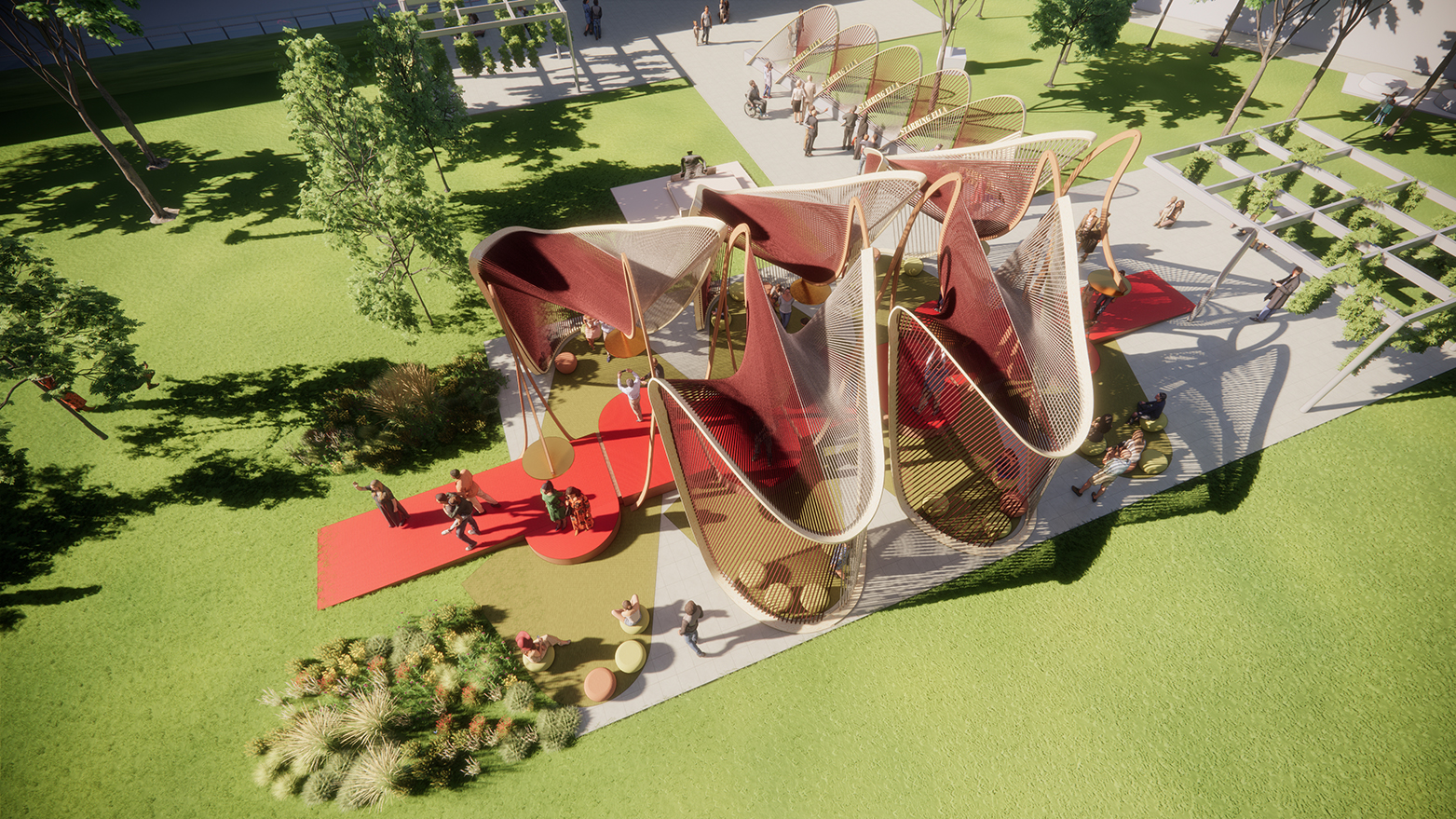
    This speculative pavilion encourages visitors to walk the red carpet across seven stages, inspired by Shakespeare’s verse.

    All the world’s a stage,
    And all the men and women merely players.
    They have their exits and their entrances,   
    And one man in his time plays many parts,   
    His acts being seven ages.’

    William Shakespeare

    Reminded of our collective mortality in a post COVID world, the passage of time has been on our minds. This experimental pavilion gives visitors the opportunity to consider their own life stages, and the metaphorical actors and audience that have participated in each.

    Simultaneously, we also live in a time when always-on media encourages people to pursue their fifteen minutes of fame. This proposal taps into this narcissistic vein, with an interactive display wall that allows visitors to spell their own names and indulge in a photo opportunity before taking to the stage.

    The visitor experience through the pavilion is linear. The seven stages unfold via an entry ramp at Stage 1, Infancy and exit ramp at Stage 7, Dotage. A bold red carpet welcomes visitors to traverse it, while two hues of rope – one creamy white, the other deep maroon – creating ever changing colours and pattern on the pavilion floor. The stage experience is enhanced by a single metal disc over each stage that reflects the light and references the spotlight of the stage. The experience culminates in a north facing landscaped pocket of native planting.

    Laminated timber frames create a vaulted structure, recalling the curtains of theatre that open to reveal the acts behind. Drawing from the theatre with its world of rope rigging, natural rope provides dappled shade, while the moiré effect presents users with an everchanging experience along their linear journey. The audience seating before each stage recalls the sandbags of pulley fly-towers. The density of the ropes increases as the actors progress through the stages – the metaphorical curtain closing – before emerging into a landscaped pocket of native planting.

  • Pixelplants

    Pixelplants

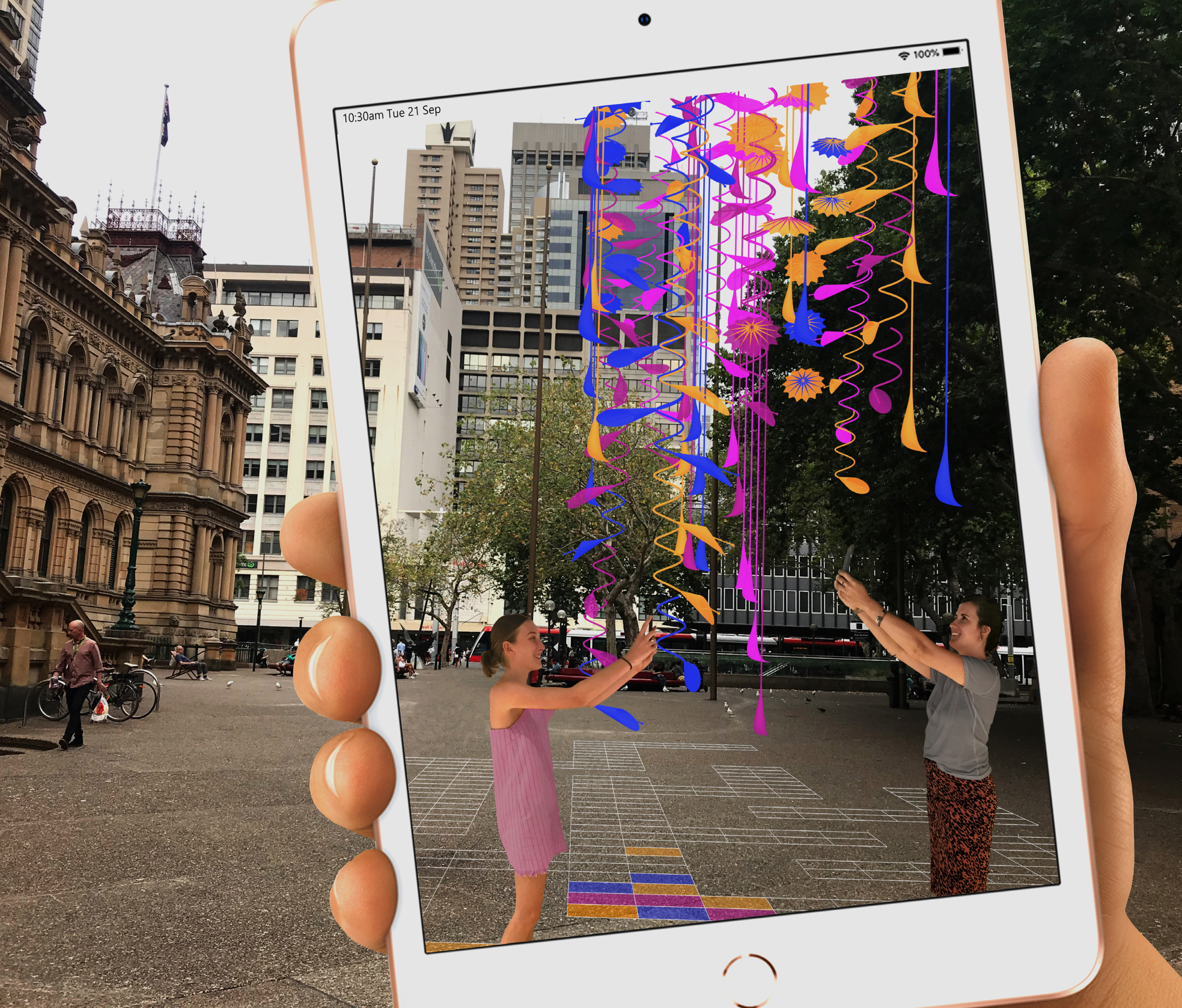
    Pixelplants is a speculative AR art installation conceptually based on the traditional walled garden. 

    The installation tries to do three new things:
    1. Direct foot traffic in Physical space using Virtual content
    2. Encourage ppl to care about a patch of land, and visit this, based on Augmented Content
    3. Induce a sense of ownership over a physical site using digital content.

    The artwork invites participants to plant virtual seeds and view the resulting PIXELPLANTS in Augmented Reality (AR) through their mobile device. The virtual plants may be customised, and grow down to the ground from an overhead datum based on preset algorithms. Eventually, the PIXELPLANTS form thickets of virtual vegetation that define pixellated ‘walls,’ reminiscent of the hedging in traditional walled gardens; and the aggregation of these walls defines a maze.

    Should a user accidentally walk into the ‘No-Go Zones’ of the virtual maze, haptic feedback from their mobile device will disrupt their AR experience, effectively directing people through physical space using virtual cues.

    PIXELPLANTS encourages repeat visits to a real-world site by stoking participants’ interest in the plight of their virtual PIXELPLANTS. The artwork proposes the Mixed Reality equivalent of the whimsical flower-plucking game ‘S/he loves me/ loves me not’, which traditionally manifests through the plucking of one daisy’s petal for each spoken phrase.

    PIXELPLANTS similarly invites participants to ask a YES/NO question of their chosen seed before planting, with the number of flowers produced algorithmically by the time the plant reaches the ground resulting in a YES/ NO response. Coupled with participants’ ability to customise their PIXELPLANT by assigning it colours and characters, this promise of an answer encourages participants to return to the same physical space, traversing a virtual maze in the process.

    Ultimately, PIXELPLANTS seeks to demonstrate that public space may be impacted by geolocated virtual concent in ways as yet unexplored by the architects and city planners who shape its physical attributes. 

    This project was presented at the Living Futures Oceania Summit 2021.
  • Now You See Me

    Now You See Me

    Now You See Me is a hypothetical interactive installation informed by the COVID pandemic.

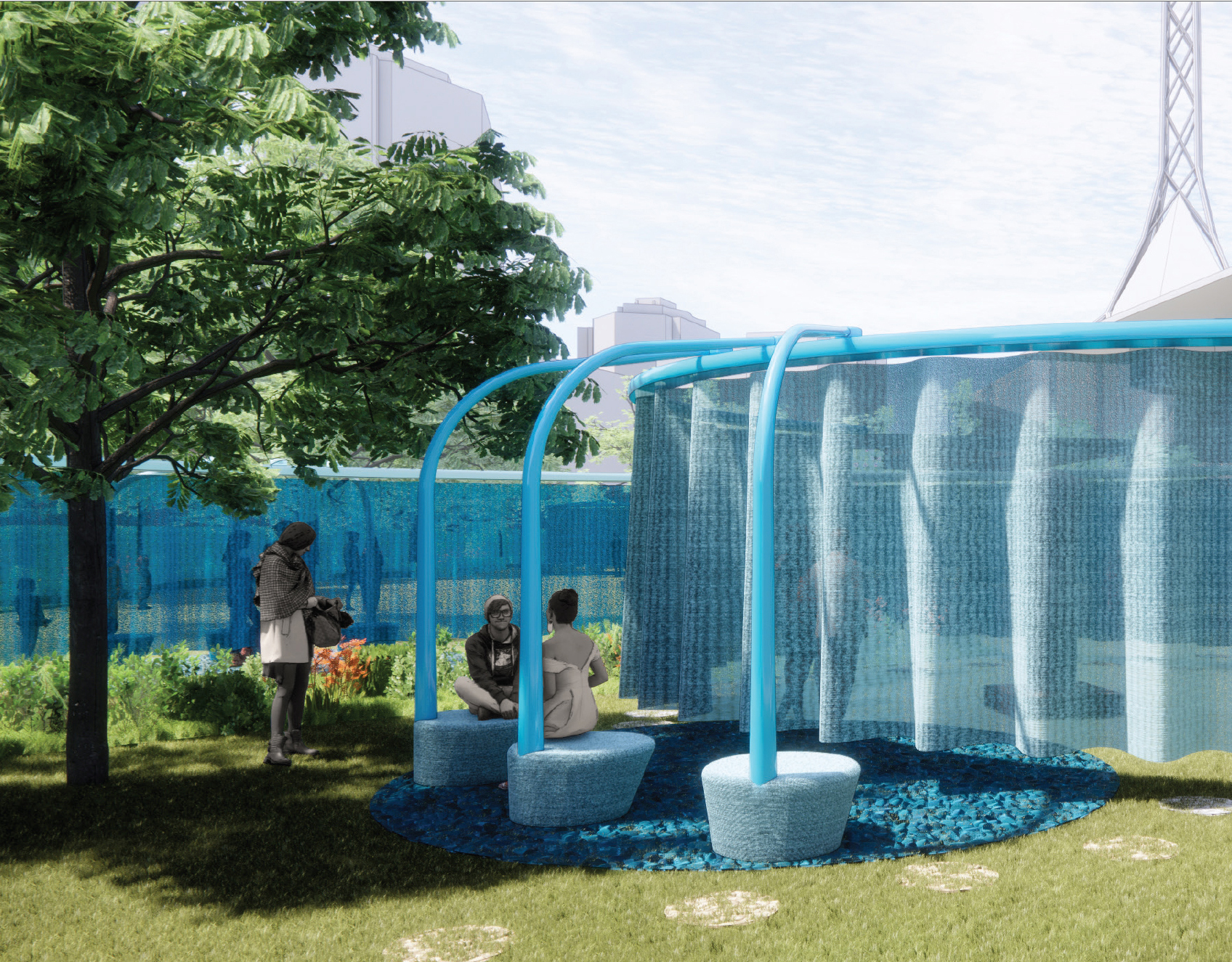
    The installation uses mobile curtains to block or open vistas between neighbouring sculptures, and create everchanging pockets of space within an existing public garden. The curtains continually roam the garden in response to visitors’ movements.

    Each curtain forms a physical link between two adjacent sculptures, scribing an infinity loop in plan to symbolise the sculptures’ connection. But when a high number of visitors approach either sculpture, the connection between the two is lost: motion sensors signal the curtain to protect the sculpture, and it automatically draws to close. 

    By extending out into a physical barrier, the curtain interrupts the visual corridor between neighbouring sculptures. Simultaneously, it encircles viewers in an open-air room, whose horizon is reduced to the adjacent sculpture, nearby trees and sky above. By alternating between hiding and revealing its subjects, the installation continually reshapes viewers’ spatial experience, capturing the state of flux effected by pandemic lockdowns.

  • Clapiconia

    Clapiconia

    Winner of an IESANZ Award of Commendation, CLAPICONIA was an interactive sound and light installation commissioned by Destination NSW for VIVID Light 2014. 

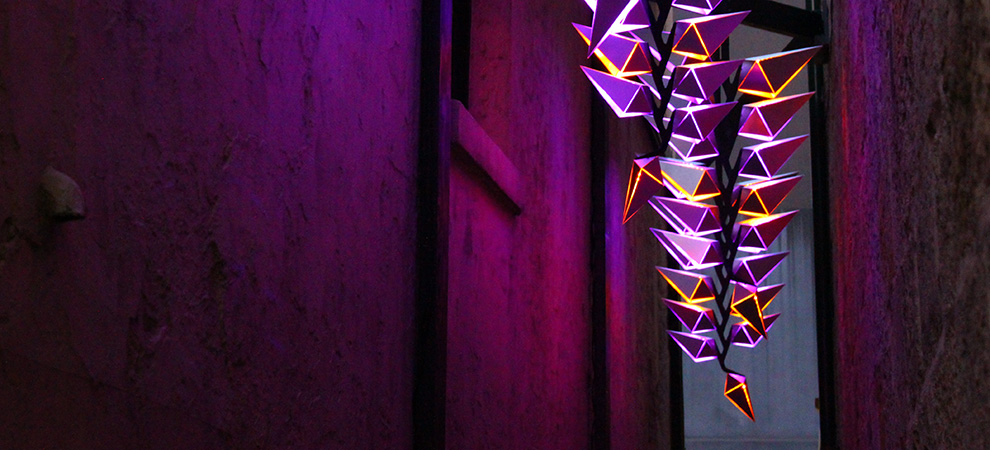
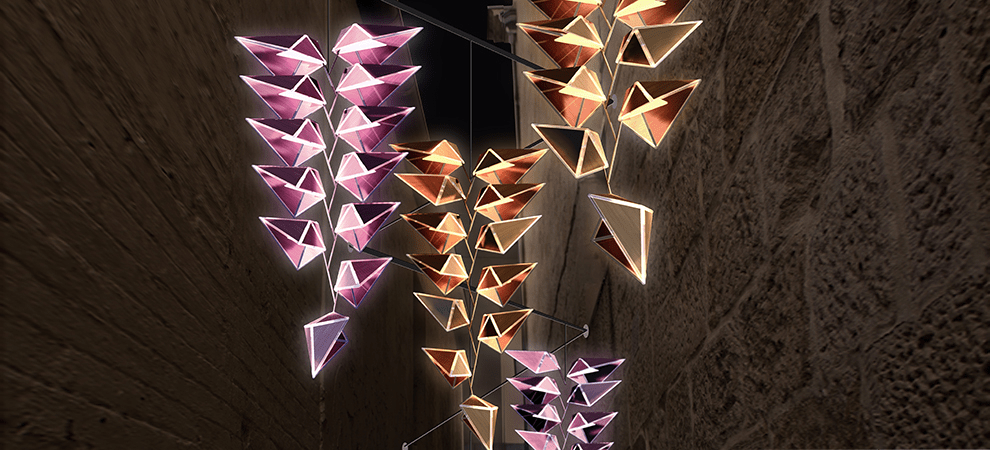
    CLAPICONIA loves to perform, enticing people off George Street in The Rocks into the Suez Canal. Clap for it, and its stylised flower pods become illuminated castanets that snap open and shut to each stem’s individual rhythm.

    Conceptually, CLAPICONIA is inspired by the Heliconia pendula plant – a native of the tropical Americas and Pacific Islands. The installation’s stylised interpretation consists of flat, triangular aluminium panels reflecting the brightly lit stamen inside – recalling the festive colours of percussion castanets. The flat panels are joined together to form ‘pods,’ whose malleable edges allow the flower to fold open and snap shut during ‘performance’. Solenoids enable the stylised pods to snap shut in tune to each stem’s unique rhythm.

    With its interactive castanets, bright colours, and clapping sounds, CLAPICONIA invited passers-by to join in a cacophony of sound. It was installed in the Suez Canal in The Rocks, Sydney, from May 23 – June 9 2014.

    Project Team: Rana Abboud (Design), Ewen Wright (Technical & Fabrication). Special Thanks to Xavier Nuttal, (Structural Engineer).

    Links 

    https://www.nzherald.co.nz/entertainment/vivid-sydney-struck-by-lighting/HVZVB5QUAWLQ6CGBUJDYJFMCOA/?c_id=1501119&objectid=11646634
    Publication – Sidelights Awards 2014

  • Unfurlii

    Unfurlii

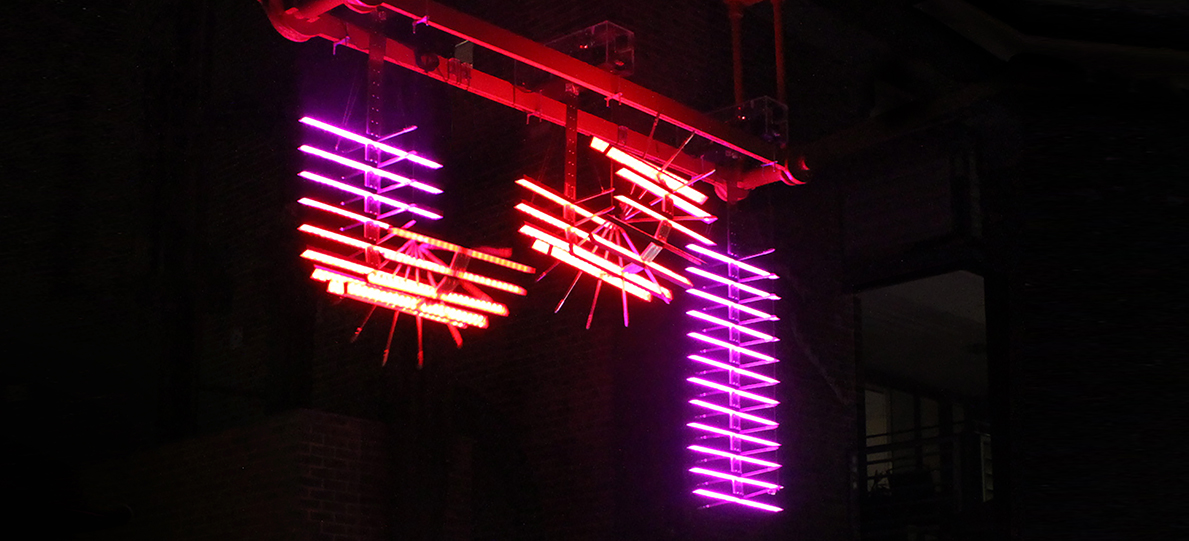
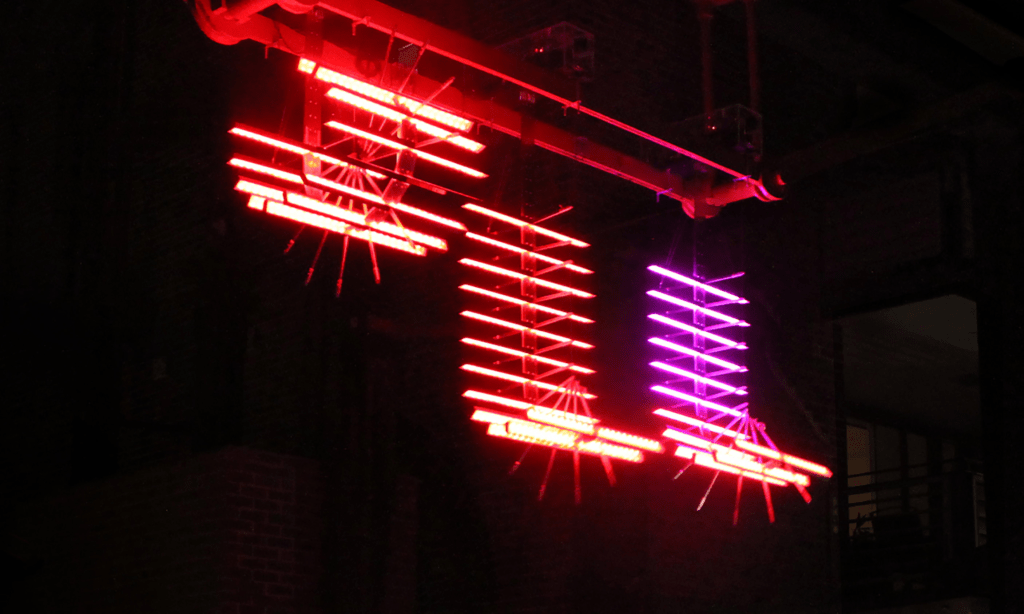
    Winner of an IESANZ Award of Commendation, UNFURLII was an interactive sound and light installation commissioned by Destination NSW for VIVID Light Sydney 2016. 

    UNFURLII is the collective noun for a group of shy, luminescent creatures that unfurl to relax and coil when approached. Reach up to an individual Unfurly and it will retreat to safety by curling up and away.

    Conceptually inspired by the unfurling motion of a fern, each Unfurly stem consists of translucent light bars connected to cables that allow the stem to curl and unfurl in response to motion below. Motors at the top of each stem alternate between pulling and releasing on the stem’s cables, pulling the light bars up and drawing their spokes into a radial pattern, thereby curling them into a protective stance.

    Motion beneath the Unfurly is detected by sensors that signal to the stem to protect itself, pulling it up and out of harm’s way. Lower your arms and the Unfurly feels safe, soon relaxing down for a rest.

    The design of the UNFURLII installation is deliberately minimal, to draw attention to their movements and the play of light. The simple bars can flex and twist in response to wind and weather conditions, and computer controlled LEDs allow the bars to change colour in sync with their movements.

    The delicate cables of the UNFURLII are in keeping with the maritime setting of Walsh Bay. Basking in the expansive water and sky views of their setting, their ‘natural habitat’ provides an uninterrupted backdrop against which the luminous stems can play.

    Project Team: Rana Abboud (Design), Ewen Wright (Technical & Fabrication). Special Thanks to Timothy Uren, programming legend; and Xavier Nuttal, engineering hero.

    Links 

    https://www.stuff.co.nz/entertainment/80586637/Kiwi-artists-take-on-Sydneys-Vivid-festival
    https://www.vividsydney.com/event/light/unfurlii
    https://www.nzherald.co.nz/entertainment/vivid-sydney-struck-by-lighting/HVZVB5QUAWLQ6CGBUJDYJFMCOA/?c_id=1501119&objectid=11646634
    Publication – Beautiful Monsters
    Publication – Sidelights Awards 2016

  • Digitalis

    Digitalis

    An interactive sound and light installation commissioned by Destination NSW for the 2013 VIVID Light Festival.

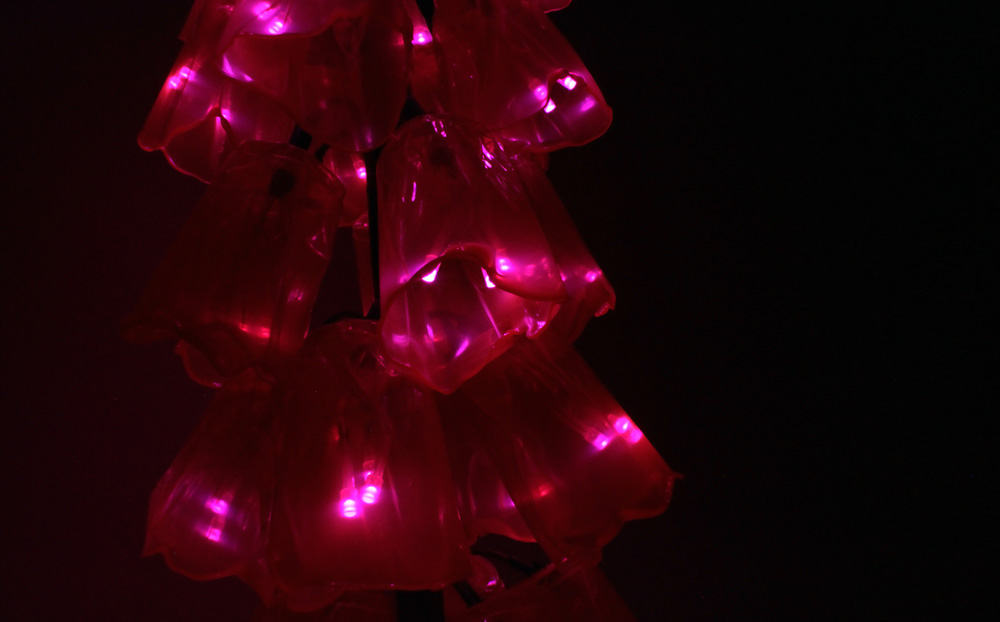
    DIGITALIS is conceived as a genetically modified breed of the toxic plant Digitalis Purpurea, and fuses unrelated objects to create a new, modified hybrid. Low-tech recyclable materials are used in unusual ways to create an interactive presence: crumpled plastic cups become flower bells with glowing LED stamen.

    This franken-plant responds to ‘threats’ on its territory in the same way as a rattlesnake warns off predators by rattling its tail. Each plant stem is linked to a proximity sensor that is triggered when people approach it. The activated sensor triggers a motor that vibrates the plant, causing its fluorescent cups to clatter against one another. Simultaneously, the plant’s dimmable LED lights glow brighter.

    Project Team: Rana Abboud (Design), Ewen Wright (Technical & Fabrication). Special Thanks to Timothy Uren, programmer extraordinaire; Anton Grimes, model-making legend; and Charles Fortin for the hero photos!

    Links 

    http://www.nzherald.co.nz/travel/news/article.cfm?…
    http://blog.worldarchitecturenews.com/?p=4057