Category: Speculative

  • Chrysalis Relocatable School

    Chrysalis Relocatable School

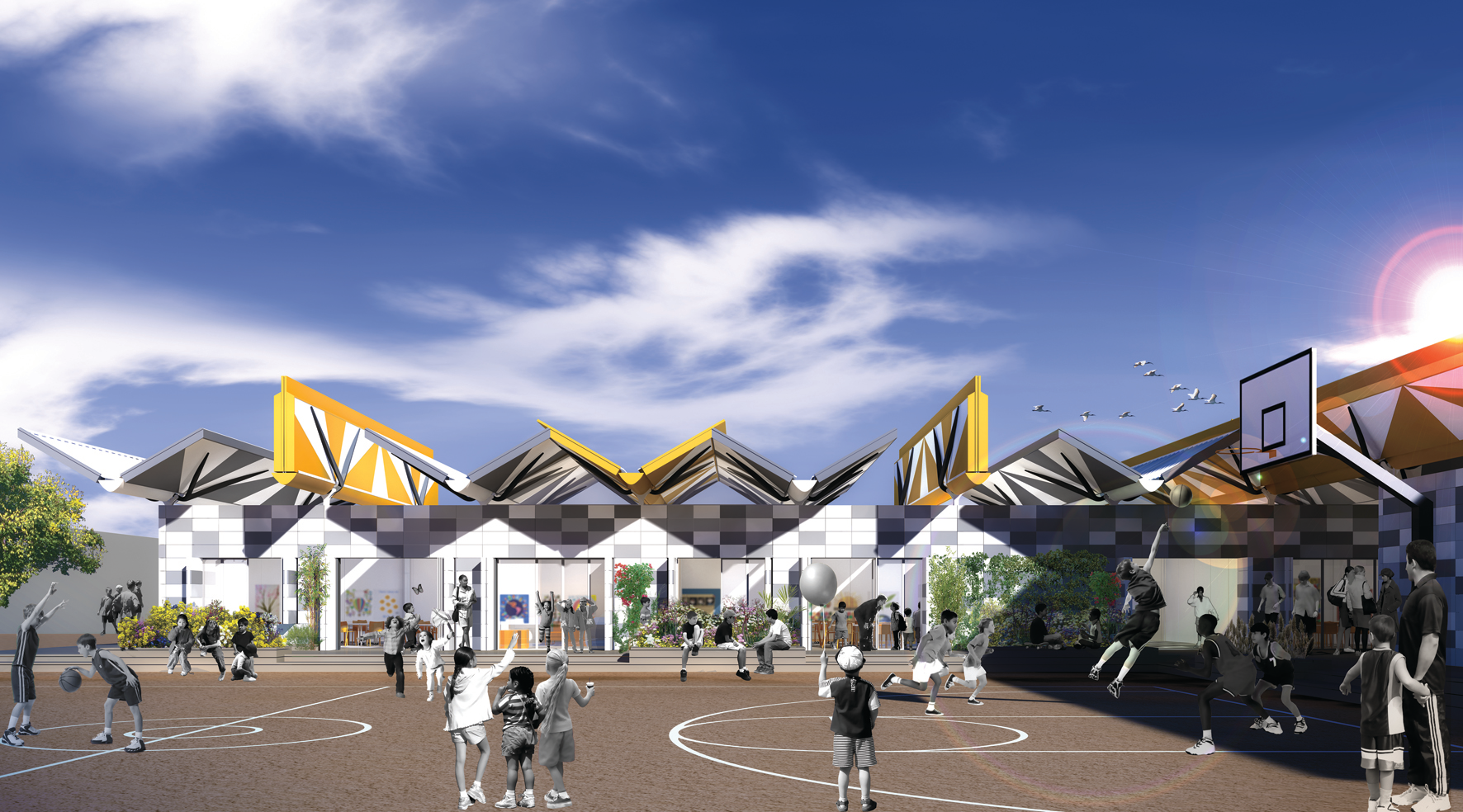
    Conceptually inspired by the emergence of a butterfly from its cocoon, Chrysalis is a modular system of relocatable learning environments.

    Metaphorical butterfly ‘wings’ -operable portions of roof- open the spaces beneath to the sky, with colours drawn from native Australian butterflies. Each Chrysalis arrives to its end site folded into a ‘dormant’, compact form. Hydraulic pistons within the structural columns push up the wings of the roof, allowing the walls to rotate into place. The pistons then expand, lifting the roof elements into their ‘flying’ configuration, and the butterfly emerges from its dormant stage (‘eclosion’).

    The Chrysalis’ modular facade is based on a 300 x 600mm grid of recycled cement panels that camouflage connections between components. Disparate modules can be connected according to the requirements of their end schools, allowing a flexible “mix-and-match” of interior layouts and end function. The suite of add-on elements within the Chrysalis lexicon include modules for bathrooms, offices, and stairs, with additional storeys able to be accommodated as required. The transformation of the Chrysalis is a subtle nod to the transformative power of learning.

    Chrysalis relocatables can be orientated to maximise their northern aspect, and photovoltaic cells on each north-facing roof portion power the buildings’ lighting and electrical needs. The operable ‘wings’ of the roof act as giant horizontal louvres that shield their inhabitants from direct sun penetration by day, and allow the building to passively ventilate by night.  High level retractable windows enable natural cross-ventilation of the spaces below, and all openings employ double-glazing, low-E coatings, and thermally broken frames.

    Planters designed into the verandahs provide outdoor seating, and climbing plants gradually cover areas of the facade, allowing the relocatables to visually ‘grow’ into their surrounding environments. Lightweight recycled membranes anchored to built-in planters provide shade and informal seating to common outdoor spaces, and link the relocatables into their existing school fabric. The Chrysalis’ roof collects rainwater, and uses this to irrigate toilets and surrounding landscaping.

    A Building Management System manages air quality, temperature and CO2 levels indoors. Artificial light levels respond to changes in external conditions, and water usage is controlled throughout the building. Mechanical air systems within the building temper air below-ground, delivering fresh air via air-con supply grilles in the floor.   Digital display panels placed throughout common areas provide information to students on aspects of the buildings’ management and performance.

    Publication – Reflections

  • Laneway House

    Laneway House

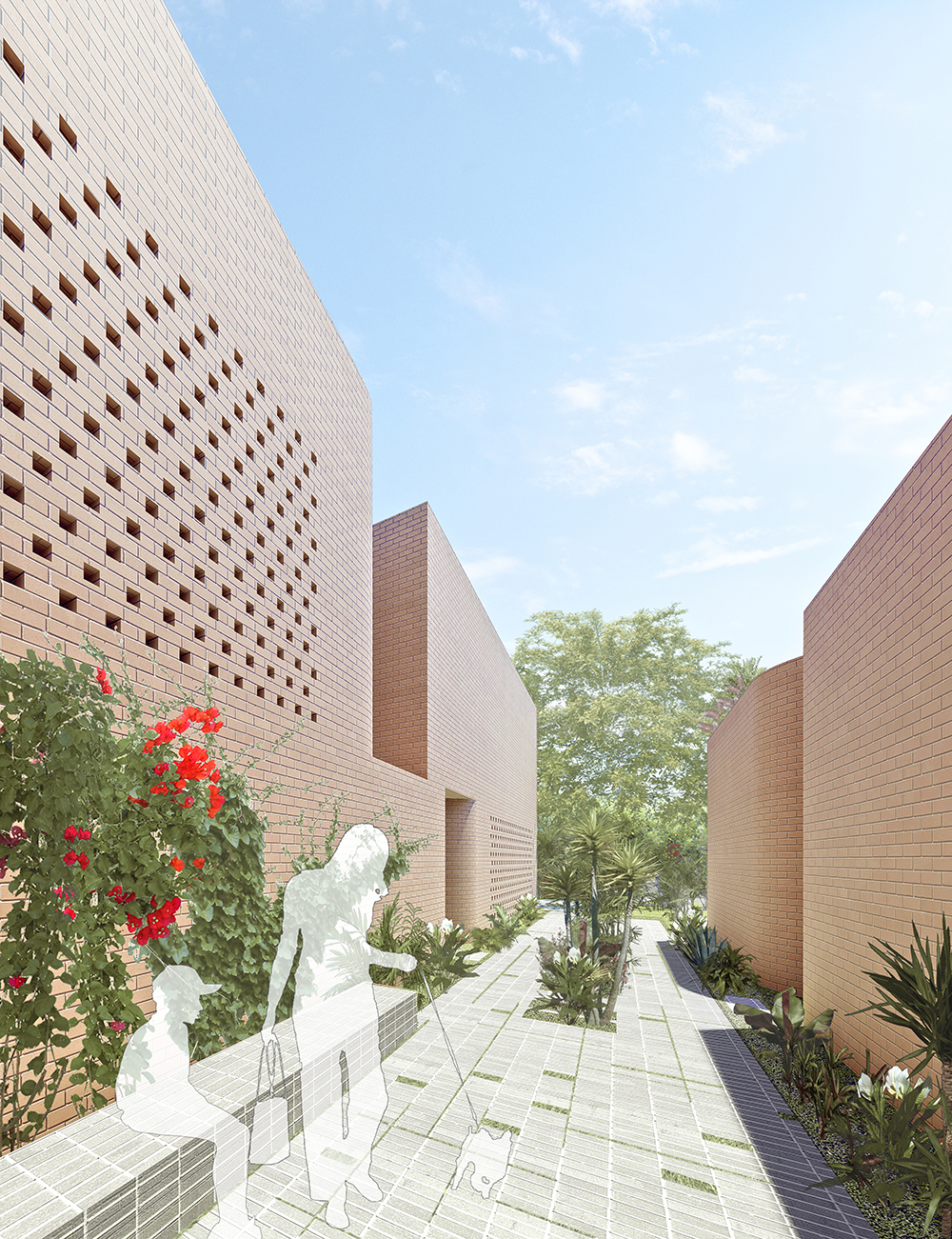
    Laneway House amalgamates under-utilised slithers of land either side of the traditional boundary fence into a green suburban laneway.

    Laneway House breaks from the existing suburban condition of large houses with limited open space. The house adapts to the aging family over time and proposes multiple stages of construction, with building timeframes tailored to the family’s budget. The design addresses the 21st century desire to electronically work from home, while promoting ‘real-time’ social interaction with neighbours via the laneway. In its many guises, Laneway House can variously accommodate its original family; a granny flat; home office; teen retreat; or wholly new family, once the original empty-nesters downsize and subdivide their lot – all while retaining the full amenity of their shared green laneway.

    The exterior walls of Laneway House extend into the landscape to delineate inside from out, and provide privacy from the lane. Borrowing from the terrace model, skylights draw light into the internal spaces, with further ambient daylighting provided through brick screens opening onto the laneway. Operable glass within the cavity brick screens provides opportunity for through-breezes, and beds of solar cells on the roof reduce the power draw of the house. Externally, the all-too dominant lock-up garage gives way to discrete parking pads that cater to compact, lightweight cars of the future. Brick used throughout the landscaping provides planting beds, benches, and paving with gaps that allow plants to grow through, softening the impact of the built elements, and allowing nature to further alter the house over time.

  • Shock Pods

    Shock Pods

    What if the lightning released in a thunderstorm could be harnessed to power entire cities?

    This prototype skyscraper draws formal inspiration from the native Banksia plant of Australia.

    The Vault is the generative element of the design, and the vault ribbing directly reflects the suburban grid beneath. The location of the house is offset from its neighbours, affording residents views out through landscaping to the street while minimising overshadowing to adjacent buildings. Inhabitants car-share to reduce their environmental impact, accessing parking pods along the street via a brick-paved thoroughfare connected to the house.

    The Banksia has follicles, or ’pods’, that may release their seeds after many years of lying dormant by opening if burnt or subjected to a similar heat. In a similar vein, ‘the Shock Pods’ are fueled by lightning shocks, capturing the rainwater from a thunderstorm within the openable pods, and electrolysing the water using the power from a lightning strike to break the atomic bond of a water molecule.

    During a thunder storm, there is enough energy discharged to power Australia for approximately three hours. With over 2000 thunder storms world wide at any one time, it is an abundant source of energy. By converting this electrical potential energy to chemical potential energy, it can be safely stored between storm events. When the pods are empty they open again to the sky, a visual reminder to the residents of the city the availability of energy and the process of its generation.

    This project submitted to the eVolo Skyscraper Competition was included in the Limited Edition Book ‘EVOLO SKYSCRAPERS’, which features the best 300 projects selected from more than 4000 entries received between 2006 to 2011.

    The Shock Pod Skyscrapers was part of the EMAGN 2012 Exhibition ‘The Fringe Experience’ at the State Library of Queensland, Brisbane, from May-June 2012.

    Project Team: Rana Abboud (Design), Ewen Wright (Technical).
    Publication – Evolo Skyscrapers

  • Vault House

    Vault House

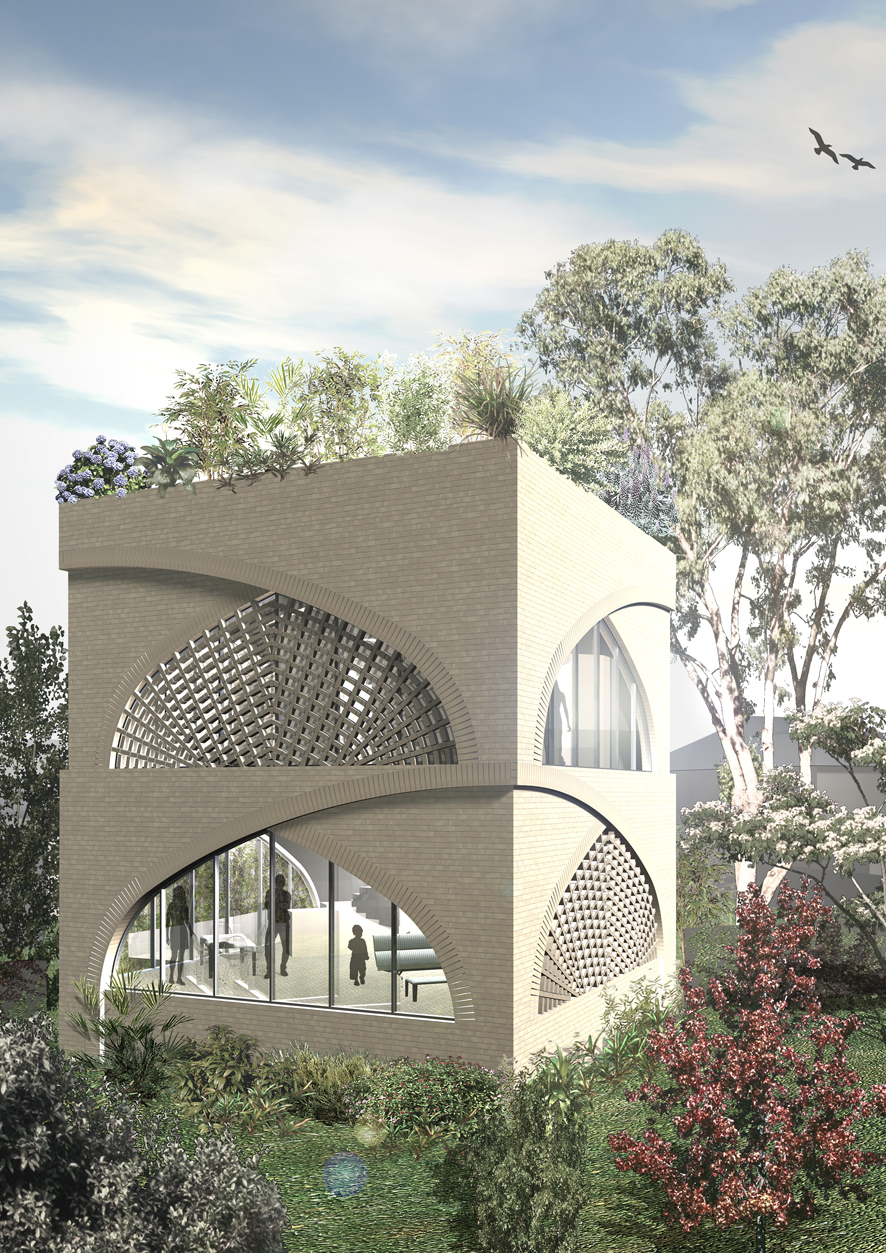
    Winner of Think Brick’s 2011 Open Face Award, Vault House is a proposal for a sustainable suburban house built of brick.

    The competition called for entries to envision a future for the Australian suburb that embraced increased densities while accepting the established desire to engage with suburban life. Vault House amalgamates the underutilised corners of large, quarter-acre suburban lots into small plots that can accommodate new houses. The Vault House prototype positions itself at the junction between four suburban lots within Sydney’s St Ives, and lies over 13m away from its neighbours. A landscaped buffer surrounds the house, effectively screening it from adjacent properties.

    The Vault is the generative element of the design, and the vault ribbing directly reflects the suburban grid beneath. The location of the house is offset from its neighbours, affording residents views out through landscaping to the street while minimising overshadowing to adjacent buildings. Inhabitants car-share to reduce their environmental impact, accessing parking pods along the street via a brick-paved thoroughfare connected to the house.

    Brick is used throughout Vault House as structure, ceiling, screening, and floor paving. Austral Bricks’ Dry Pressed Standard bricks in Charolais Cream are placed in Herringbone and Stretcher Bond patterns on floors and walls respectively; while Special Shape bricks, cut and interspersed with standard bricks, create radial patterned screening that throws lace-like shadows when in full sun. High vaulted ceilings overhead and a day-lit oculus give a sense of spaciousness to the interior, and truncated partition walls allow uninterrupted views of the bricks overhead.

    Vault House is naturally cross-ventilated, with operable windows and a roof hatch over the central oculus to allow stack cooling. Brick screening and secondary roller blinds mitigate sun penetration in summer, while the brick vault massing is a sustainable thermal store in winter.

    Links 

    https://architectureau.com/articles/arm-matthew-gribben-among-the-winners-at-this-years-think-brick-awards/
    Publication – Think Brick Australia Award Winners
    Publication – Think Brick Open Face Award
    Publication – Monument

  • Nine Dot House

    Nine Dot House

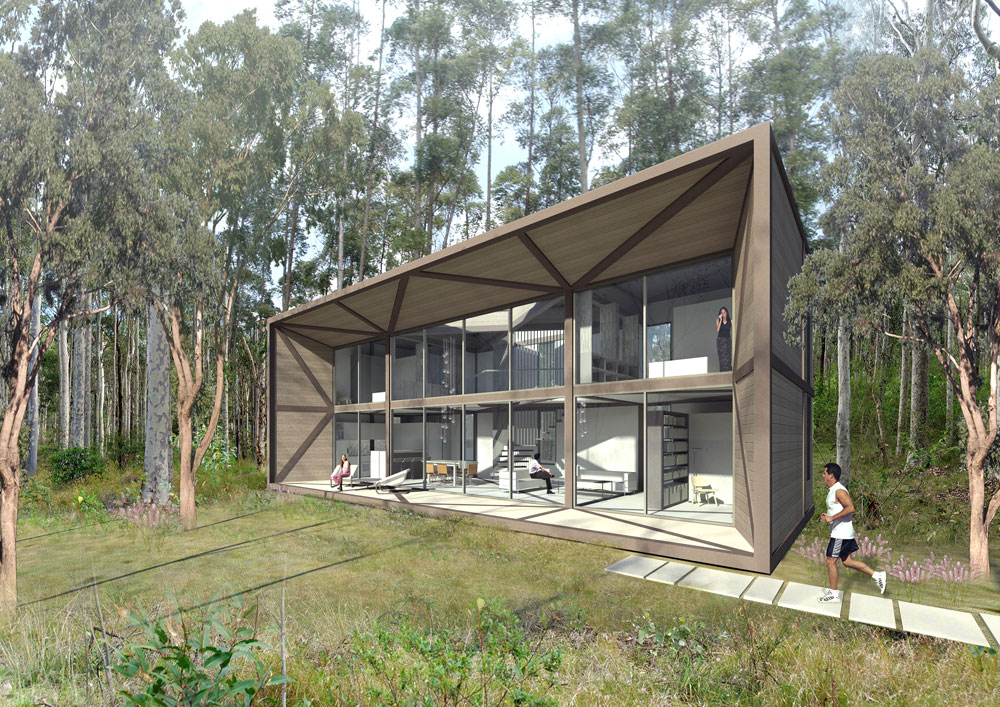
    Winner of Cemintel’s 2012 ‘9 Dots Award’, 9 Dot House is a holiday house that draws inspiration from its natural setting.

    Nestled within a grove of eucalyptus trees in regional NSW, the house proposes new uses for off-the-shelf products to meet the design competition brief and ‘think outside the nine dots’.

    9 Dot House reconfigures the original ‘nine dot puzzle’ to blur its visual boundaries and challenge viewers’ expectations of the associated building form. The original nine dots ensnare observers into imagining a perceived boundary around the dots, leading viewers to think ‘within the box’ while the solution lies beyond; the scattered dots of 9 Dot House suggest a free-form enclosure, yet the house plan retains orthogonal boundaries. 

    Conceptually and structurally, 9 tree-like columns underpin the house design. A retreat from the bustle of the city, there is a playful suggestion of the tree-house in the walkways to the upstairs bedrooms, and grandeur of the double height spaces within.

    Cemintel products provide a rich palette of textures and colours that complement the hues of eucalypt leaves and bark outside. Woodgrain ‘Maple’ panels externally visually blend the house into its surroundings. CNC-milled Barestone panels provide adjustable shading and privacy screening to the north.  Dappled light filtering through these panels recalls the house’ leafy surrounds, and contrasts with the solid Barestone defining the wet areas internally. I-Cube ‘Onyx’ panels are reconfigured as shutters to the upstairs bedrooms, and provide feature panelling to the kitchen bench downstairs. In a setting prone to bush fire, Cemintel products provide non-combustible, low-maintenance exteriors befitting a holiday house.

    Links 

    https://www.architectureanddesign.com.au/editorial/industry-news/product-wins-csr-cemintel-9-dots-award
    https://www.architectureanddesign.com.au/editorial/Fire-Protection-9-Dot-House
    Publication – Building Products News Nov 2012. Vol 48. No 10

  • Sundials

    Sundials

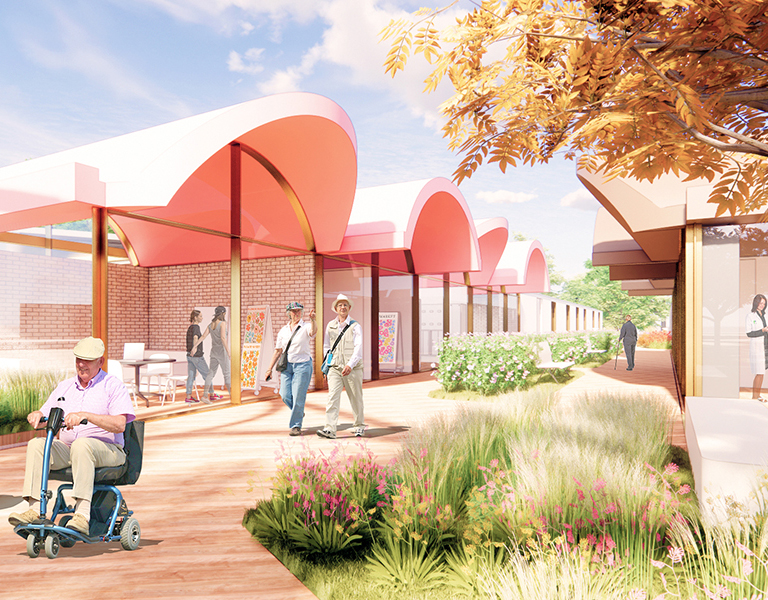
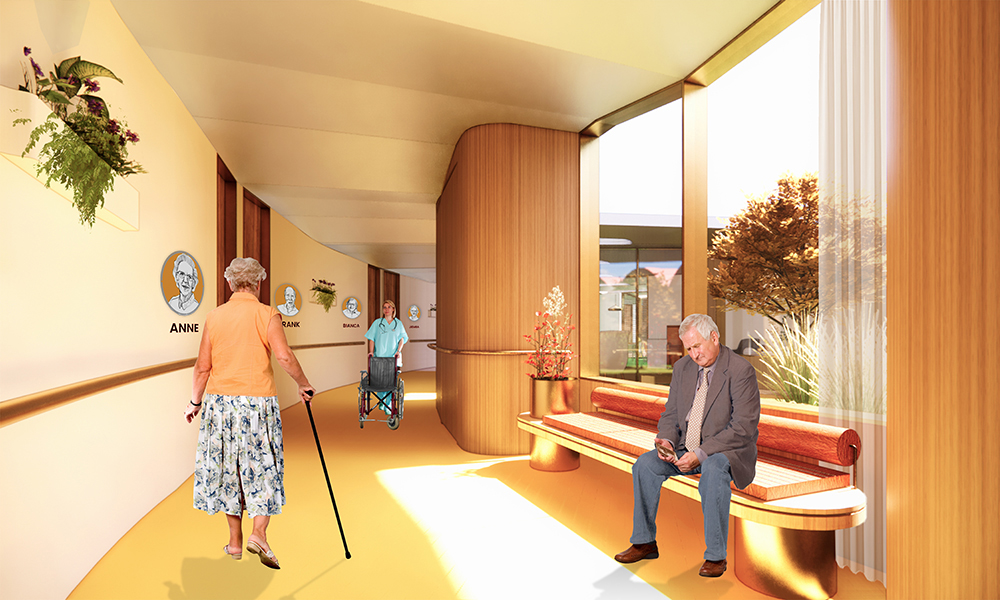
    A residential aged care development with bedrooms opening to landscaped terraces.

    Put simply, exposure to nature enhances well-being. This is the thinking behind Sundials, a speculative residential aged care facility.

    Households are small, and contain two internal courtyards – one roofed, one open air – within landscaped grounds that offer a multitude of different outdoor settings. The modular Sundials household may be placed on any site and oriented to maximise daylight, with overhead BMS-controlled skylights allowing fresh air and sunlight to each bedroom.

    At the micro level, each household provides 11 typical single bedrooms with ensuites, and 2 bedrooms for more than one person (15 people in total), as well as a bedroom for visitors. The bedrooms radiate out towards the gardens. Some have terraces, that permit residents to plant their own vista; while others do not, accommodating residents whose health needs preclude gardening. The interior of the households boast two colour schemes, to aid with way-finding. Communal spaces are clustered at the centre of the household, with easy access out to internal courtyards, while the bedrooms at the periphery maximise residents’ exposure to the gardens.

    Household back of house areas are grade-separated, both for security, to prevent residents accidentally accessing these areas, but also to increase the available area of high-value ground plane and deep soil zones. This freed-up ground level enables a wider offering of communal programme to activate this site, including services that benefit the wider community, from a café, to a small florist, and changing places facility opposite a multi-function community room for 60 people. At the heart of the scheme is a community yarning circle, that provides a place for residents and the wider community to gather and connect. The Sundials communal spaces are all within colourful arched laneways, with key functions colour-coded for ease of identification. 

  • All The World’s A Stage

    All The World’s A Stage

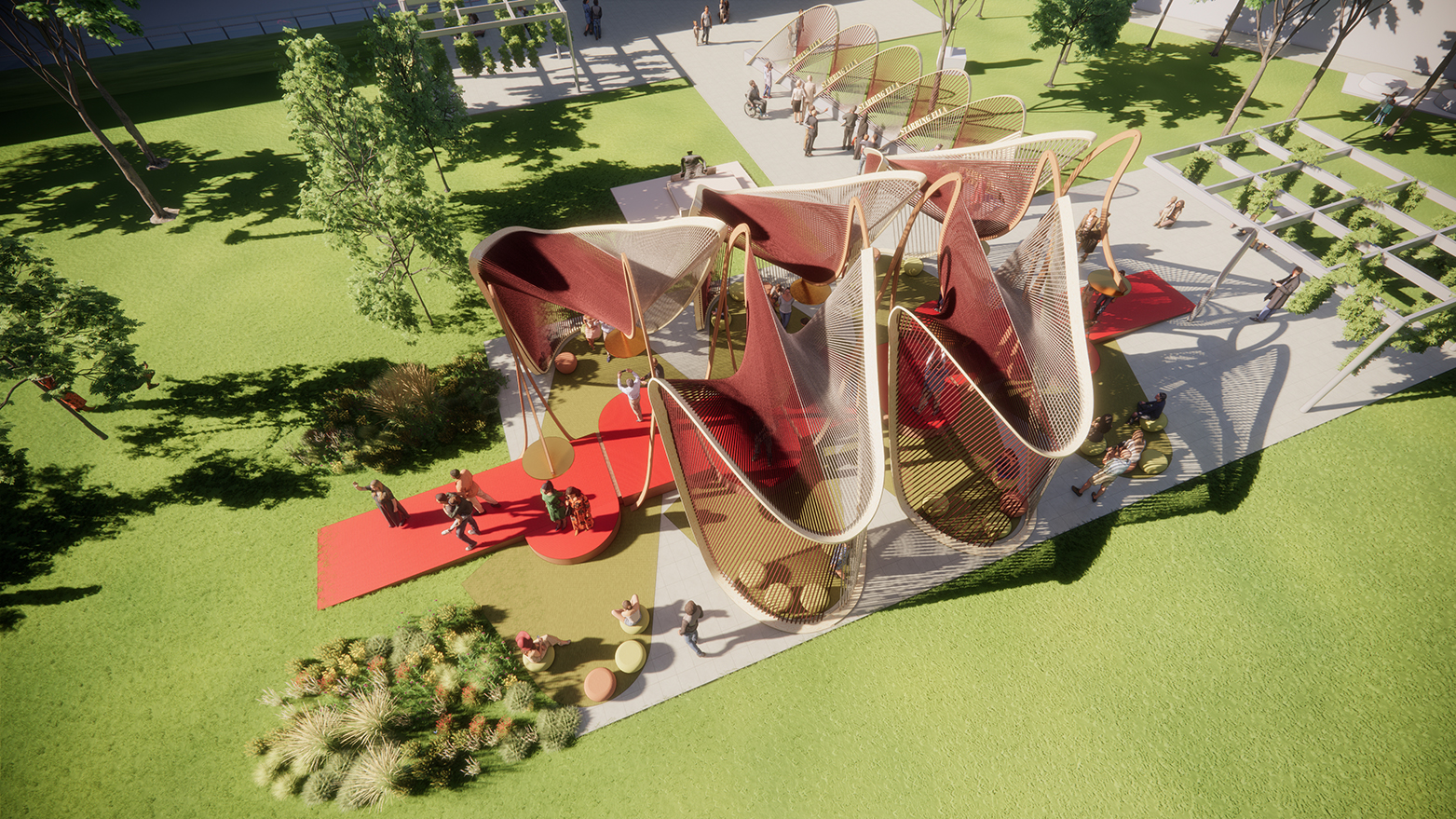
    This speculative pavilion encourages visitors to walk the red carpet across seven stages, inspired by Shakespeare’s verse.

    All the world’s a stage,
    And all the men and women merely players.
    They have their exits and their entrances,   
    And one man in his time plays many parts,   
    His acts being seven ages.’

    William Shakespeare

    Reminded of our collective mortality in a post COVID world, the passage of time has been on our minds. This experimental pavilion gives visitors the opportunity to consider their own life stages, and the metaphorical actors and audience that have participated in each.

    Simultaneously, we also live in a time when always-on media encourages people to pursue their fifteen minutes of fame. This proposal taps into this narcissistic vein, with an interactive display wall that allows visitors to spell their own names and indulge in a photo opportunity before taking to the stage.

    The visitor experience through the pavilion is linear. The seven stages unfold via an entry ramp at Stage 1, Infancy and exit ramp at Stage 7, Dotage. A bold red carpet welcomes visitors to traverse it, while two hues of rope – one creamy white, the other deep maroon – creating ever changing colours and pattern on the pavilion floor. The stage experience is enhanced by a single metal disc over each stage that reflects the light and references the spotlight of the stage. The experience culminates in a north facing landscaped pocket of native planting.

    Laminated timber frames create a vaulted structure, recalling the curtains of theatre that open to reveal the acts behind. Drawing from the theatre with its world of rope rigging, natural rope provides dappled shade, while the moiré effect presents users with an everchanging experience along their linear journey. The audience seating before each stage recalls the sandbags of pulley fly-towers. The density of the ropes increases as the actors progress through the stages – the metaphorical curtain closing – before emerging into a landscaped pocket of native planting.

  • Pixelplants

    Pixelplants

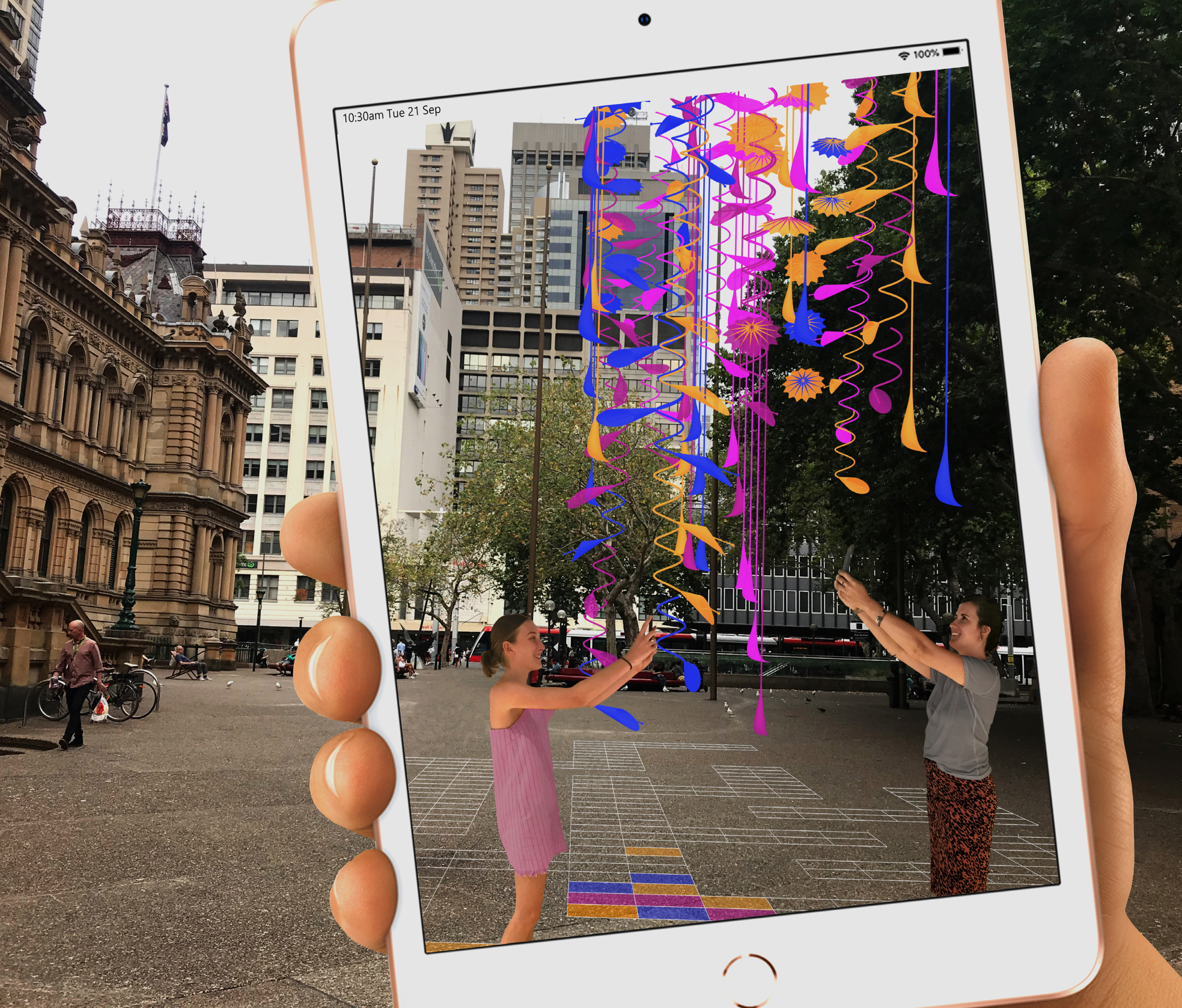
    Pixelplants is a speculative AR art installation conceptually based on the traditional walled garden. 

    The installation tries to do three new things:
    1. Direct foot traffic in Physical space using Virtual content
    2. Encourage ppl to care about a patch of land, and visit this, based on Augmented Content
    3. Induce a sense of ownership over a physical site using digital content.

    The artwork invites participants to plant virtual seeds and view the resulting PIXELPLANTS in Augmented Reality (AR) through their mobile device. The virtual plants may be customised, and grow down to the ground from an overhead datum based on preset algorithms. Eventually, the PIXELPLANTS form thickets of virtual vegetation that define pixellated ‘walls,’ reminiscent of the hedging in traditional walled gardens; and the aggregation of these walls defines a maze.

    Should a user accidentally walk into the ‘No-Go Zones’ of the virtual maze, haptic feedback from their mobile device will disrupt their AR experience, effectively directing people through physical space using virtual cues.

    PIXELPLANTS encourages repeat visits to a real-world site by stoking participants’ interest in the plight of their virtual PIXELPLANTS. The artwork proposes the Mixed Reality equivalent of the whimsical flower-plucking game ‘S/he loves me/ loves me not’, which traditionally manifests through the plucking of one daisy’s petal for each spoken phrase.

    PIXELPLANTS similarly invites participants to ask a YES/NO question of their chosen seed before planting, with the number of flowers produced algorithmically by the time the plant reaches the ground resulting in a YES/ NO response. Coupled with participants’ ability to customise their PIXELPLANT by assigning it colours and characters, this promise of an answer encourages participants to return to the same physical space, traversing a virtual maze in the process.

    Ultimately, PIXELPLANTS seeks to demonstrate that public space may be impacted by geolocated virtual concent in ways as yet unexplored by the architects and city planners who shape its physical attributes. 

    This project was presented at the Living Futures Oceania Summit 2021.
  • Now You See Me

    Now You See Me

    Now You See Me is a hypothetical interactive installation informed by the COVID pandemic.

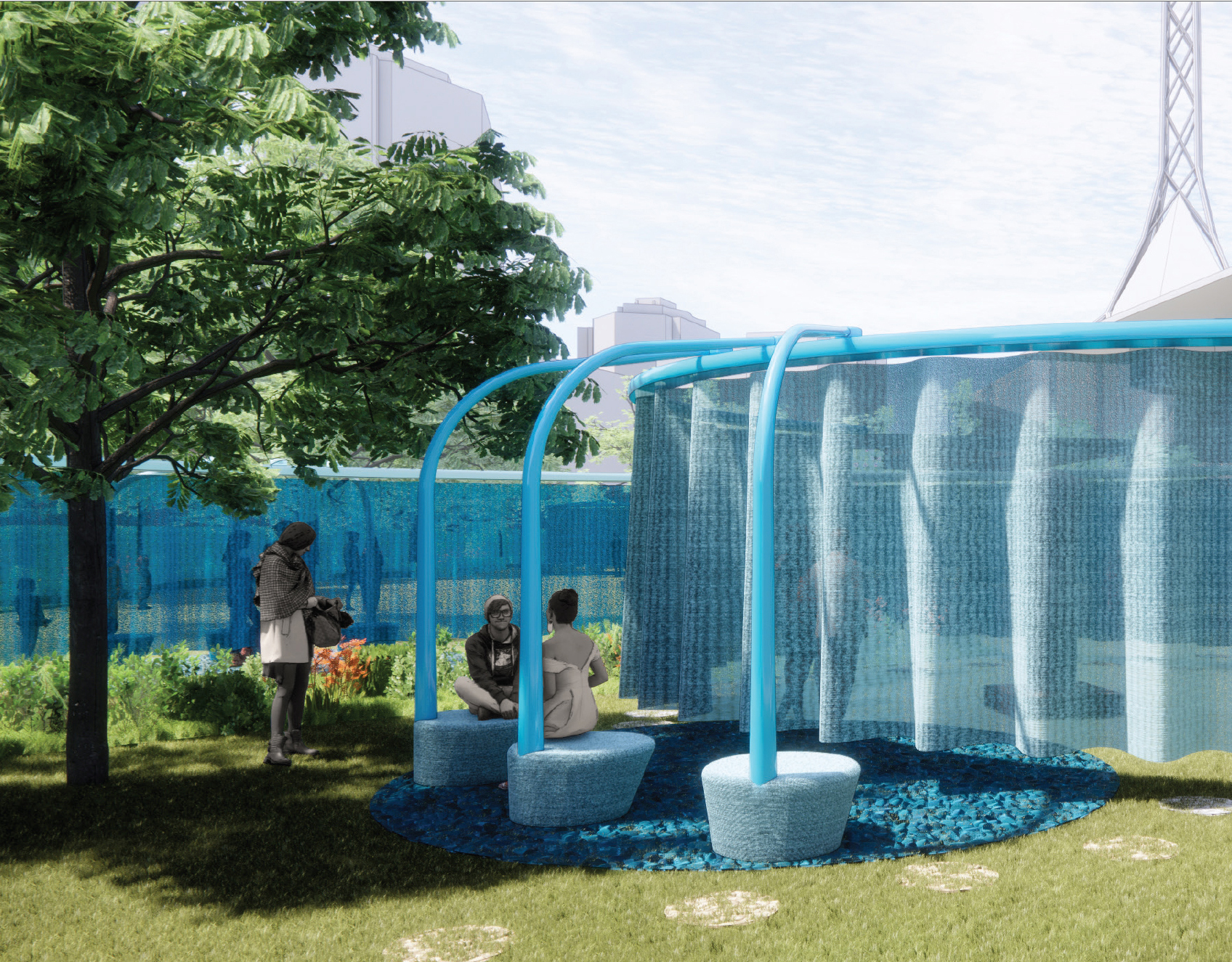
    The installation uses mobile curtains to block or open vistas between neighbouring sculptures, and create everchanging pockets of space within an existing public garden. The curtains continually roam the garden in response to visitors’ movements.

    Each curtain forms a physical link between two adjacent sculptures, scribing an infinity loop in plan to symbolise the sculptures’ connection. But when a high number of visitors approach either sculpture, the connection between the two is lost: motion sensors signal the curtain to protect the sculpture, and it automatically draws to close. 

    By extending out into a physical barrier, the curtain interrupts the visual corridor between neighbouring sculptures. Simultaneously, it encircles viewers in an open-air room, whose horizon is reduced to the adjacent sculpture, nearby trees and sky above. By alternating between hiding and revealing its subjects, the installation continually reshapes viewers’ spatial experience, capturing the state of flux effected by pandemic lockdowns.